MaxiDry.tech · Exclusive Nateen
Dry is not a quantity.
It is a construction.
Anyone can make a product heavy and fill it with superabsorbent. Keeping skin dry — fast, under body pressure, through the night, in real urine rather than tap water — is a different discipline. It is the sum of hundreds of decisions on polymers, fibres, layers, adhesives and process, each one validated on a running production line.
The shortcut
“Make it heavy, add more SAP.” No — it is more than that.
Superabsorbent polymer is the heart of the product, but piling it on does not buy dryness. Too much polymer in the wrong place swells into a seal that stops liquid from reaching the rest of the core. The surface stays wet, the product gets stiff and heavy, and the leak happens anyway.
Dryness comes from balance: the right polymer in the right place, a fibre network that moves liquid, layers that take in a surge in seconds and give nothing back. That balance is what we engineer.
Five disciplines
What goes into MaxiDry.tech
Each page of this site opens one of the disciplines we have combined, year after year, on our own lines.
Polymers
Choosing the superabsorbent
Grade, producer, particle size, speed and behaviour under load — selected per model and per size, and mixed when one grade cannot do everything.
Architecture
Proportions and layers
Layer order, weights, widths and the degree of mixing between fibre and polymer. Proportion is the product.
Materials
Fibres, adhesives, elastics
Long or short cellulose, synthetic and bicomponent fibres, hot-melts, spandex tension. Absorption is only one of the problems.
Method
The line lab
Fifteen years of prototypes produced, sampled, tested and worn on real production lines — not on paper.
Position
Engineering vs labels
What separates a brand that engineers and tests from a brand that prints a bag on a stock product.
Closures
Tapes & closures
On a brief, the fit decides the leak: tape width, adhesion, hook engagement, position.
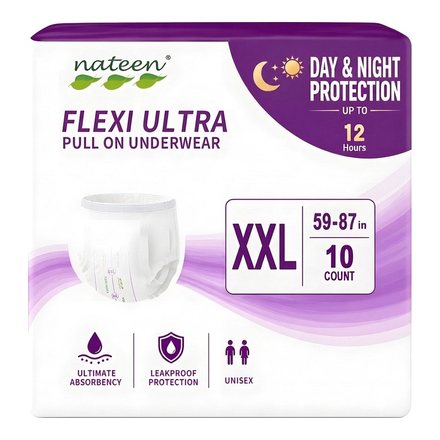 Flexi UltraPull-up underwear · ultra absorbentSee in the shop →
What we measure
Three numbers, honestly measured
- Capacity — Rothwell method (ISO 11948-1), in 0.9 % saline, the standard stand-in for urine.
- Speed — rate of absorption of repeated surges (NWSP 070.9).
- Rewet — how much comes back to the surface under pressure (NWSP 070.9).
For moderate and heavy products we add absorption before leakage on an adult mannequin (NWSP 354), the figure hospital tenders ask for.
Why saline and not water? Urine carries dissolved salts. Ions shrink what a superabsorbent can hold, so a “water” figure flatters the product. We publish the saline figure.
Questions
Frequently asked
What is MaxiDry.tech?
MaxiDry.tech is Nateen’s absorption engineering: the choice of superabsorbent polymers, fibres, layer proportions, adhesives, elastics and closures, validated over fifteen years on production lines, to develop the world’s most absorbent pull-ons and briefs.
Does more superabsorbent make an incontinence product drier?
Not beyond a point. Excess superabsorbent, especially fine particles, swells into a seal (gel blocking) that stops liquid reaching the rest of the core, so the surface stays wet. Placement, particle size and layer design matter more than quantity.
Why is absorption measured in saline instead of water?
Urine contains dissolved salts, and ions reduce how much a superabsorbent can hold. A 0.9 % saline solution is the standard stand-in for urine, so a saline figure reflects real use while a water figure overstates it.
Which tests measure the performance of adult incontinence products?
Capacity with the Rothwell method (ISO 11948-1), speed of absorption and rewet with NWSP 070.9, and absorption before leakage on an adult mannequin with NWSP 354 for moderate and heavy products.
 Nateen products
This engineering, in our products
Flexi UltraPull-up underwear · ultra absorbentMLXL2XLSee in the shop →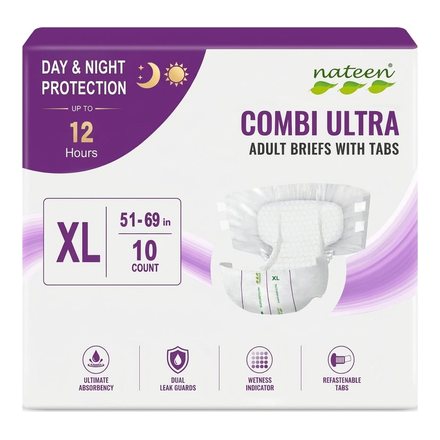 Combi UltraBrief with tabs · our most absorbentMLXLSee in the shop →
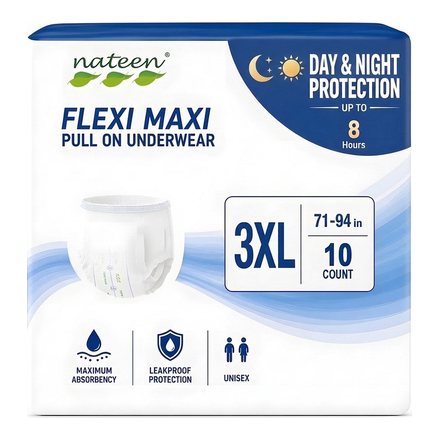 Flexi MaxiPull-up underwear · overnightMLXL2XL3XLSee in the shop →
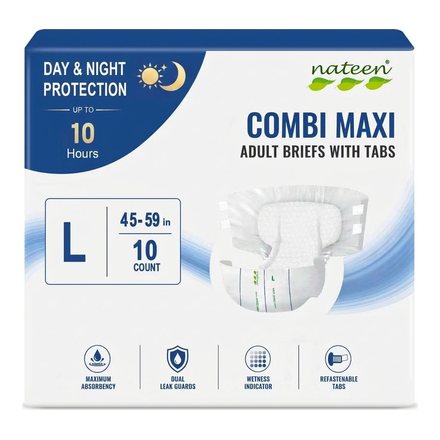 Combi MaxiBrief with tabs · maximum protectionSMLXLSee in the shop →
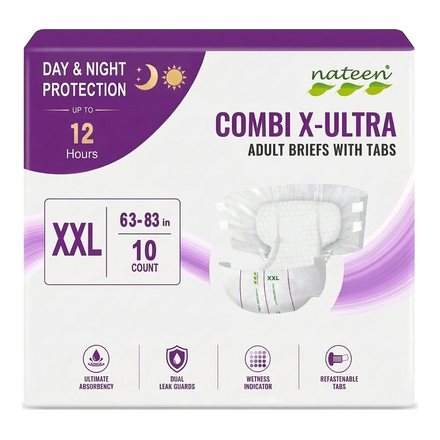 Combi X-UltraBrief with tabs · up to 5XLMLXL2XL3XL4XL/5XLSee in the shop →
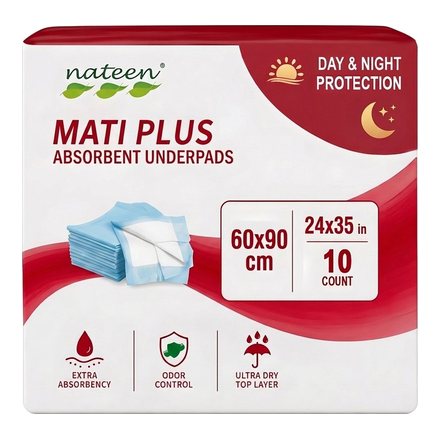 Mati PlusDisposable underpad60×6060×9080×180See in the shop →