Discipline 03 · Materials
Beyond absorption:
fibre, bond, stretch.
A product that absorbs well and falls apart wet, scratches, or loosens at the waist has failed. Fibres, adhesives and elastics are engineered with the same care as the polymer — and tested on the same line.
Cellulose
Long fibre or short fibre
Long fibres — softwood fluff pulp, a few millimetres long — build an open, springy network. It wicks liquid along the core, gives the polymer room to swell and keeps its structure when wet. This is what our cores are made of, sourced from North American fluff producers.
Short fibres — hardwood, around a millimetre — pack denser and feel smoother, but collapse when wet and wick less. They have their place in thin tissues and wraps, not as the backbone of a core.
The ratio of fluff to polymer is set per model and per size. More polymer means a thinner product; more fluff means a buffer that catches a fast surge before the polymer has time to swell.
Synthetic fibres
Engineered for one job each
- Spunbond polypropylene for soft, strong topsheets — hydrophilic finish.
- SMS (spunbond–meltblown–spunbond) for leg cuffs — hydrophobic barrier.
- Through-air bonded synthetic fibre for the ADL — loft that catches a surge.
- High-loft textile backsheet — ultra-soft, breathable, quiet.
Fibre fineness, loft and surface finish decide whether a layer drinks, passes on or repels.
Research with the pulp industry
Every point of the fibre, studied with its maker
We do not buy fluff pulp off a price list. We work with North American fluff pulp producers on each property of the cellulose, and test their pulps against our polymers on our own lines, to determine the best mixing profile between fibre and superabsorbent for each product.
The question is never “which pulp is best?” but “which pulp, defibrated how, blended with which polymer grade, at which ratio, gives the fastest, driest core for this size?”
What we study together
The fibre, parameter by parameter
- Fibre length and coarseness — the strength of the network.
- Defibration — how the pulp opens into fluff, and the knots and fines it leaves.
- Bulk and density of the pad — room for the polymer to swell.
- Wicking speed and capacity of the fibre on its own.
- Wet integrity — whether the network holds once saturated.
- The blend profile with each polymer grade, validated on the line.
Adhesives
Three glues, three problems
Too much hot-melt stiffens the product and blocks liquid between layers. Too little and it delaminates when wet. Add-on weight and pattern are specified per line.
Construction
Holds the layers
Sprayed in fine patterns so liquid still passes from layer to layer.
Elastic attachment
Holds the strands at tension
Must survive stretch, body heat and moisture without creeping.
Wetness indicator
Tells the carer
Printed lines that fade on contact with urine — a signal, not a guess.
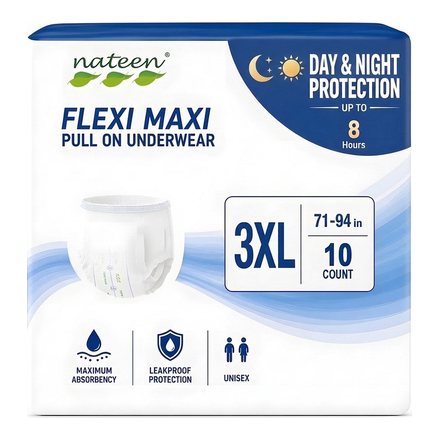 Flexi MaxiPull-up underwear · overnightSee in the shop →
Elastics
Tension is set, zone by zone
On a pull-on, spandex is laid at different stretch ratios for the front waist, the back waist, the lift-up zone and the leg cuffs — around 2.0 at the waist and 2.7 at the lift-up on our pull-ons. Too loose and it gaps; too tight and it marks the skin and rolls down.
Barrier strands in the leg cuffs stand the cuff up so liquid meets a wall rather than a crease.
Questions
Frequently asked
Why use long-fibre fluff pulp in an absorbent core?
Long softwood fibres form an open, springy network that wicks liquid, gives the superabsorbent room to swell and keeps its structure when wet. Short hardwood fibres pack denser and collapse when wet.
What adhesives are used in adult incontinence products?
Three systems: construction hot-melt that bonds the layers, elastic-attachment hot-melt that holds the strands at tension, and a wetness-indicator adhesive whose printed lines fade on contact with urine.
What is a textile backsheet (TBS)?
A soft, breathable nonwoven outer layer used instead of, or over, a plastic film. It is quieter and more comfortable against the skin and clothing.
How does Nateen choose the cellulose for its cores?
We work with North American fluff pulp producers on each property of the fibre — length, coarseness, defibration, bulk, wicking and wet integrity — and test their pulps with our polymers on our own lines to determine the best fibre–polymer mixing profile for each product.
 Nateen products
This engineering, in our products
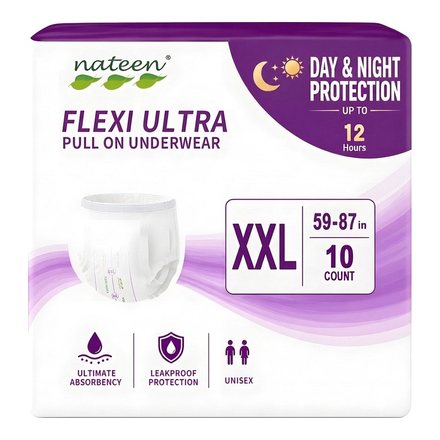 Flexi UltraPull-up underwear · ultra absorbentMLXL2XLSee in the shop →
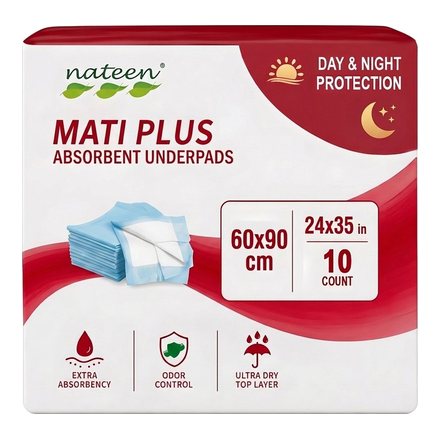 Mati PlusDisposable underpad60×6060×9080×180See in the shop →
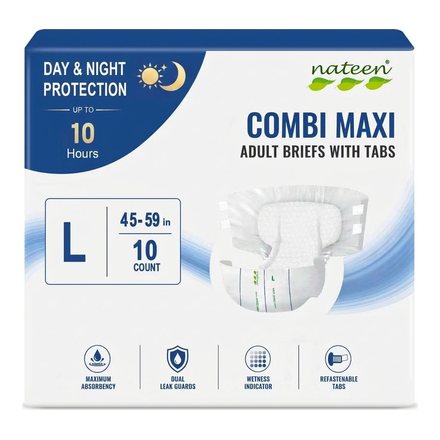 Combi MaxiBrief with tabs · maximum protectionSMLXLSee in the shop →Flexi MaxiPull-up underwear · overnightMLXL2XL3XLSee in the shop →
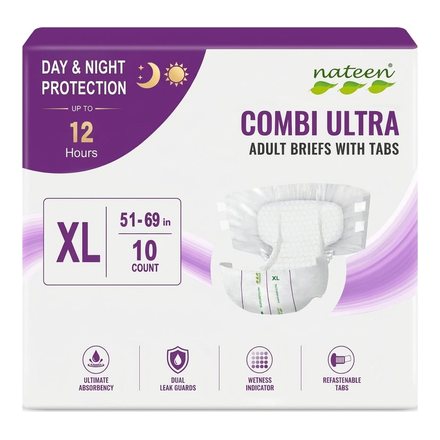 Combi UltraBrief with tabs · our most absorbentMLXLSee in the shop →
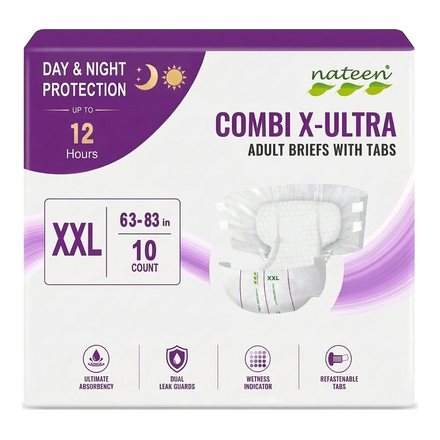 Combi X-UltraBrief with tabs · up to 5XLMLXL2XL3XL4XL/5XLSee in the shop →