Discipline 02 · Architecture
Proportion
is the product.
The same materials in different proportions make a different product. Layer order, grammage, width, the shape of the core and the degree of mixing between fibre and polymer decide how fast a surge disappears, how dry the surface stays and how the product feels on the body.
The stack
Every layer has one job
A hydrophilic topsheet lets liquid in and stays soft. Beneath it an acquisition–distribution layer of synthetic fibre catches the surge and spreads it along the core, so the polymer is used over its whole length instead of at one point.
The core — long-fibre fluff and superabsorbent in an hourglass — stores it. A multi-cored wrap — nonwoven above and below each core — holds the cores together and keeps the polymer in place, dry or wet. A breathable film or a textile backsheet stops liquid and lets vapour out. Leg cuffs in hydrophobic SMS and multi-strand elastics close the sides.
Change one weight and the balance moves: a lighter ADL is cheaper and leaks at the second surge; a heavier topsheet feels richer and slows everything down.
Degree of mixing
How polymer and fibre share the core
Fibre moves liquid by capillarity and gives the polymer room to swell. Polymer stores it. How intimately they are mixed is a design choice, made per product.
Homogeneous
Even, predictable, forgiving. The reference for everyday products.
Zoned
More polymer where the liquid lands, less where it would be wasted. Same capacity, lighter product.
Layered · dual core
A fast upper bed over a high-capacity lower bed. For night and heavy use: the surge is caught, then stored away from the skin.
Hydrophilic where it must drink
Hydrophobic where it must stop
Our waterproof top nonwoven is deliberately narrower than the product — by 70 to 80 mm depending on size. The uncovered centre is the hydrophilic zone the liquid is meant to pass through; the edges repel it towards the core instead of towards the leg.
Leg cuffs, waist panels and edge covers are hydrophobic. The topsheet, the ADL and the core are hydrophilic. Where one ends and the other begins is drawn in millimetres.
Built per size
Width is fixed, length is tuned
Roll widths are set per size and never trimmed: the product’s width is the roll’s width. Length is the cutting pitch of the machine, adjusted for each size. The proportions of every layer are therefore designed size by size — a 3XL is not an enlarged M.
Backsheets follow the same logic: a full textile backsheet on one line, a half textile backsheet — textile only over the absorbent zone, hydrophobic nonwoven on the ears — on another.
Shape and zoning
Material where the liquid goes
Core shape
Hourglass, not rectangle
The core is widest where liquid arrives and narrow between the legs, where bulk would only cause gaps and leaks.
Embossing
Patterns that guide
Embossing — hexagonal on some lines — keeps the core in place when wet and draws liquid along the product rather than to the edges.
Fit
Tension as architecture
Waist, lift-up and leg elastics are laid at set stretch ratios. Fit closes the gaps that no amount of polymer can.
Questions
Frequently asked
What layers make up an adult incontinence pull-on?
From the skin outwards: a hydrophilic topsheet, an acquisition–distribution layer, the absorbent core of fluff and superabsorbent enclosed in a multi-cored wrap, and a breathable film or textile backsheet, plus hydrophobic leg cuffs and elastics. Our Flexi Ultra L has 25 components in total.
What is an acquisition–distribution layer (ADL)?
A layer of lofty synthetic fibre under the topsheet that catches a surge and spreads it along the core so the superabsorbent is used over its whole length.
What is the difference between a homogeneous, zoned and layered core?
A homogeneous core spreads polymer evenly in the fibre; a zoned core concentrates it where liquid lands; a layered or dual core puts a fast bed over a high-capacity bed for night and heavy use.
 Nateen products
This engineering, in our products
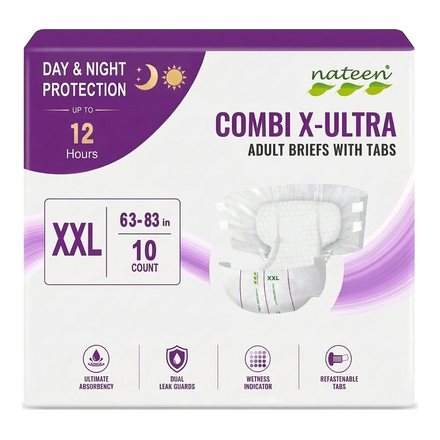 Combi X-UltraBrief with tabs · up to 5XLMLXL2XL3XL4XL/5XLSee in the shop →
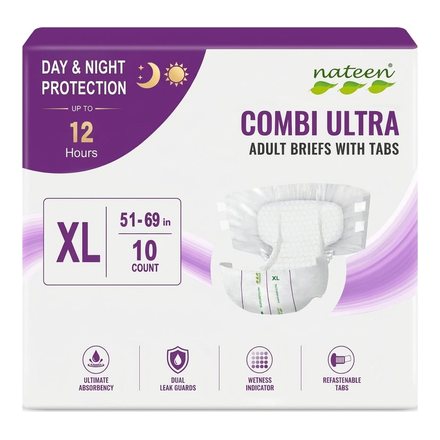 Combi UltraBrief with tabs · our most absorbentMLXLSee in the shop →
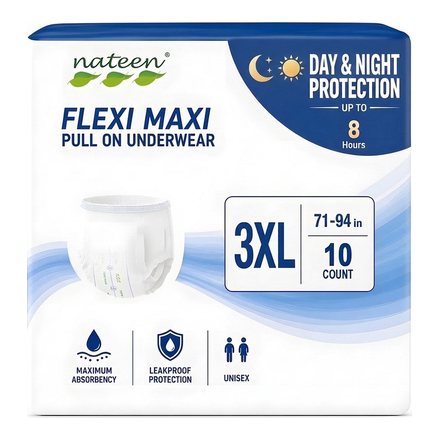 Flexi MaxiPull-up underwear · overnightMLXL2XL3XLSee in the shop →
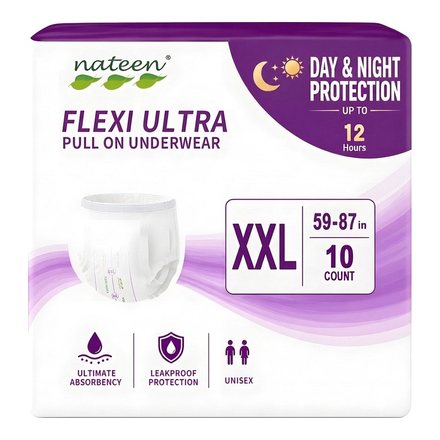 Flexi UltraPull-up underwear · ultra absorbentMLXL2XLSee in the shop →
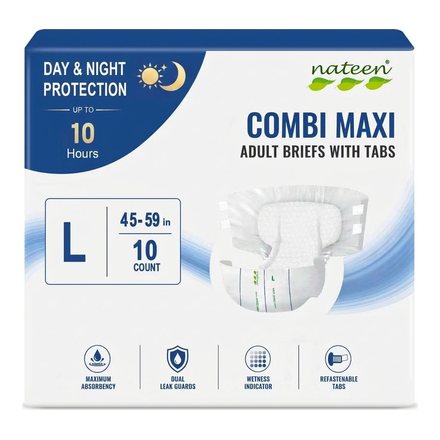 Combi MaxiBrief with tabs · maximum protectionSMLXLSee in the shop →
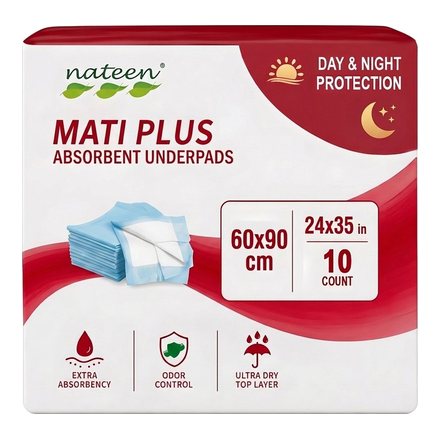 Mati PlusDisposable underpad60×6060×9080×180See in the shop →